
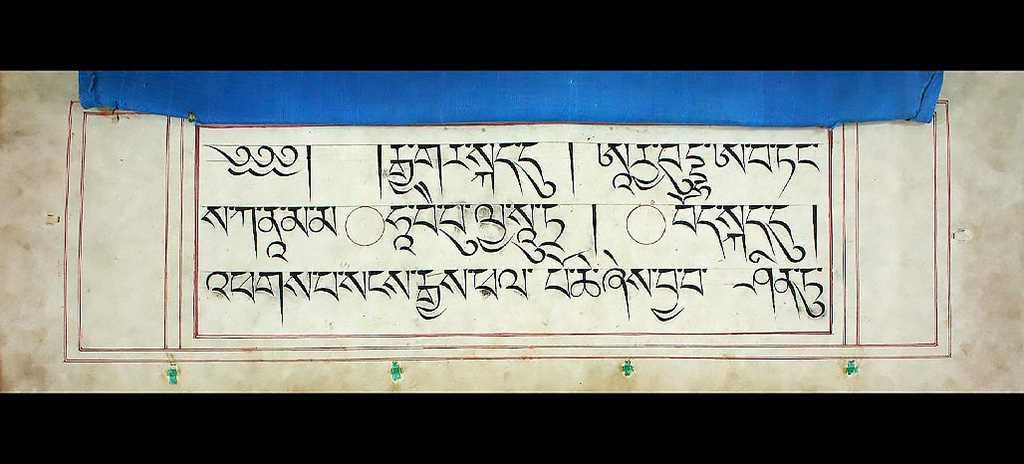
bkaʼ ʼgyur (rgyal rtse them spang ma), vol. 42, 4 Buddhist Digital Resource Center [W1KG14700]. Accessed August 28, 2024.
Speaker: Ana Cristina Lopes, Associate translator and Researcher, 84000: Translating the Words of the Buddha
Date & Time: Thursday, April 16, 2026, 5 p.m. Pacific
Venue: 370 Dwinelle Hall, UC Berkeley
Sponsor: Numata Center for Buddhist Studies, Glorisun Global Buddhist Network
Contact Info: Sanjyot Mehendale, (510) 643-5104, buddhiststudies@berkeley.edu
Access Coordinator: Sanjyot Mehendale, buddhiststudies@berkeley.edu, (510) 643-5104
Abstract: It is well known that the Buddhāvataṃsakasūtra has a long history of translation and commentary in East Asia. By comparison, little is known about the translation and reception of this sūtra in Tibet. In this presentation, I briefly introduce the Tibetan translation and early reception of the Buddhāvataṃsakasūtra, focusing on how language and imagery from the Buddhāvataṃsakasūtra figure in the Nyingtik tradition of the Nyingma School of Tibetan Buddhism. In particular, I will examine how a peculiar Tibetan translation (gang chen mtsho) of the Sanskrit term sāgara (“ocean”) was interpreted in the Nyingtik tradition as “great glacial lake” (gangs chen/can mtsho) and taken to be an epithet of Vairocana. Vairocana and this great
glacial lake image are found in various works of Nyingtik literature and other Treasure revelations influenced by it. For this presentation, I will focus on how Vairocana makes his debut as “Great Glacial Lake” in the literature of the Vimalamitra Nyingtik and in the Pema Katang, the most widely read biography of Padmasambhava in Tibetan history, revealed by Orgyen Lingpa (b. 1323) in the middle of the fourteenth century. This presentation is part of a larger research project to trace the reception history of the Buddhāvataṃsakasūtra in Tibet, and showing how the sūtra served as a focal point for the assimilation of Buddhism there.
Speaker: Ana Cristina Lopes is associate translator and researcher at 84000: Translating the Words of the Buddha. She received her PhD in cultural anthropology from the University of São Paulo and MA in Buddhist Studies from Columbia University. She held postdoctoral and research appointments at Columbia University, Harvard University, University of São Paulo, and New York University. Ana Cristina has previously taught at the University of Virginia and the University of North Carolina at Greensboro. She has also taught academic courses at Rangjung Yeshe Gomde Germany-Austria and Stanford University. She is the author of Tibetan Buddhism in Diaspora: Cultural re-signification in practice and institutions (Routledge, 2015) and other publications about the transcultural spread of Tibetan Buddhism.
See the original event posting here.


