
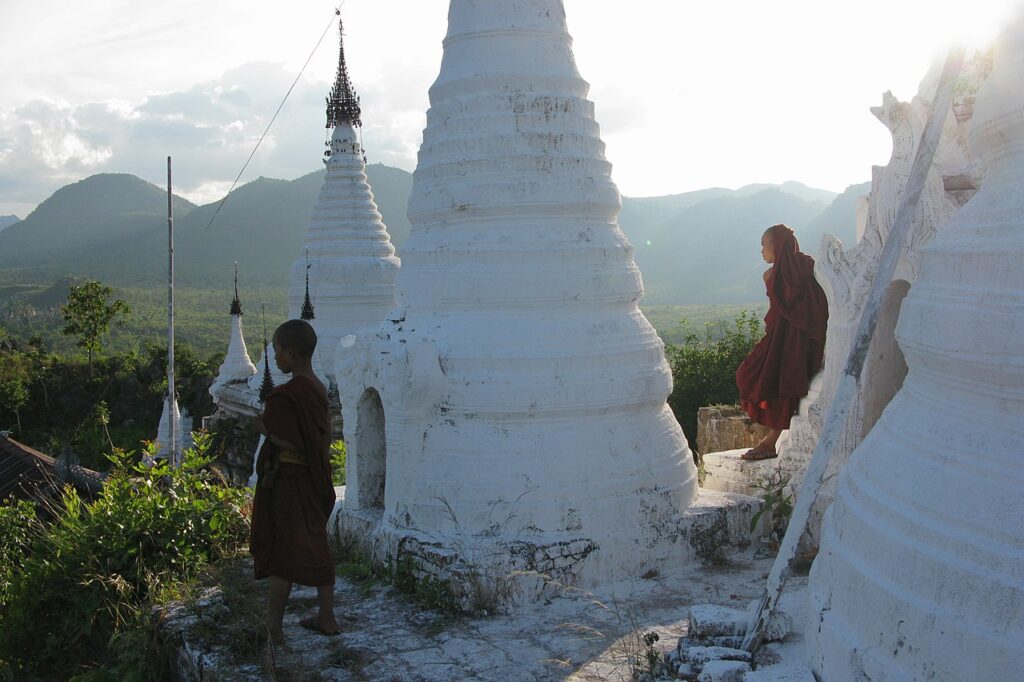
Indein, Shan State, Shan Hills, Myanmar. Source: Wikipedia.
Speaker: Sneha Roy (York St John University & University of Edinburgh)
Date: Monday 23 February 2026
Basement Teaching Room 1 at 5:00pm
Faculty of Asian and Middle Eastern Studies
Pusey Lane, Oxford, OX1 2LE
All Welcome
Glorisun Lecture Series in Buddhist Studies 2025-2026
Kindly supported by Glorisun Global Network for Buddhist Studies
Abstract:
The February 2021 military coup d’état in Myanmar dramatically reshaped the country’s political and social landscape, placing the Buddhist sangha in an ambiguous position that must balance moral authority, social responsibility and profound vulnerability. Historically central to the country’s identity and legitimacy, the sangha has had a foundational yet complex role in all major political events. Unlike previous times, the sangha is perceived to be ‘silent’or on the ‘sidelines’of the pan-Myanmar Spring Revolution against the junta. Conventionally, the use of silence is associated with powerlessness and passivity as opposed to active agency. This paper intervenes at this juncture to present that the silence of the sangha should be seen as a response to the changing religious and political values and expressions in Myanmar; and the sangha monastics use silence as a i) solidarity force; ii) strategic force and iii) utilitarian force as they navigate new pressures that shape their roles in a rapidly changing society. This paper draws on qualitative interviews conducted with twenty participants as part of a larger, ongoing research project involving a 700-person survey with PeaceRep Myanmar. While the broader project maps patterns and attitudes across diverse communities, the analysis presented here focuses on a smaller subset of the sangha monks that illuminate the lived experiences and moral reasoning underlying those patterns. The findings unpack and highlight the shifting and evolving roles of the sangha as religious and political agents, and offer novel and critical perspectives on the intersections of religious authority, resistance, and survival in post-coup transitional Myanmar.
Speaker:
Sneha Roy is a Lecturer in Religion at York St John University and a British Academy Postdoctoral Research Fellow at the School of Divinity, University of Edinburgh. She also serves as a Research Consultant with PeaceRep Myanmar and the School of Law, and is a Fellow at the Institute of Advanced Studies in Humanities, University of Edinburgh. Prior to that, she worked as a Programme Officer at KAICIID International Dialogue Centre in Vienna, where she facilitated high-level dialogue between religious and political leaders. Her research is broadly grounded in the intersections of religion, nationalism, and gender, tracing how moral and political identities are lived and negotiated within sites of continuing violence. She challenges and destabilises the normative understanding and experiences of the female religious subjects and examine their interventions at the institutional level, and within the intimate and affective dimensions of everyday life.


