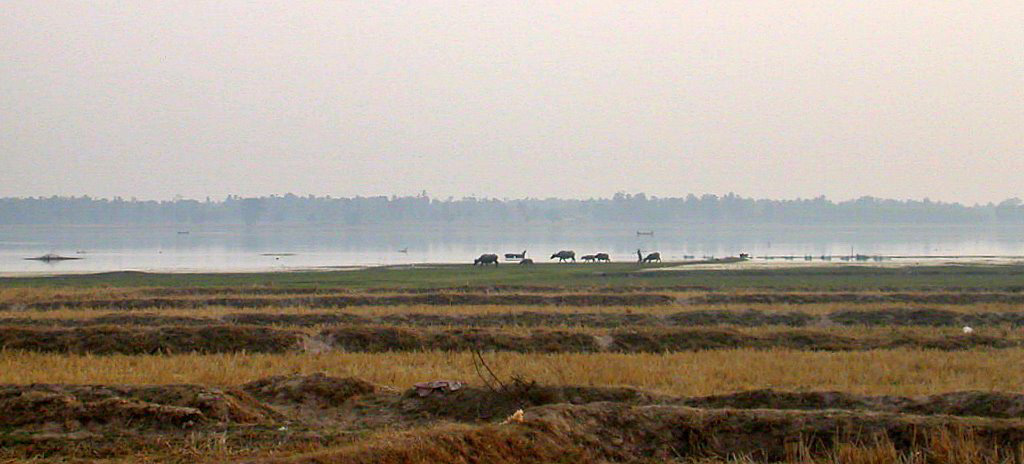
Khorat Plateau landscape, Thailand. Source: Love Krittaya, Wikipedia.
Speaker: Stephen A. Murphy (SOAS, University of London)
Date: Monday 27 April 2026
Basement Teaching Room 1 at 5:00pm
Faculty of Asian and Middle Eastern Studies
Pusey Lane, Oxford, OX1 2LE
All Welcome
Tea and snacks at 4:30-4:50pm (Common Room In the basement)
All enquiries: wanyu.zhang@ames.ox.ac.uk
Glorisun Lecture Series in Buddhist Studies 2025-2026
Kindly supported by Glorisun Global Network for Buddhist Studies
Abstract:
To what extent can we study Buddhism In a given time or place when we have little 10 no direct textual or epigraphic sources available to us? Or to put It another way, how much Information can we glean about Buddhism from the material and visual record alone? This Is the task I set myself when studying the emergence of the religion in the mid to late first millennium CE on the Khorat Plateau – a landscape of some 155,000 square kilometres of what is now northeast Thailand and central Laos.
The outcomes of this are discussed in my new book, Buddhist Landscapes Art and Archaeology of the Khorat Plateau, 7th to 11th Centuries (NUS Press 2024). Built on extensive fieldwork and archaeological surveys, it reveals that the Khorat Plateau has a distinctive Buddhist culture, Including new forms of art and architecture, and a characteristic aesthetic. Moreover, by combining archaeological and art historical analysis with an historical ecology approach, I trace the outlines of Buddhism’s spread into the
region, along its major river systems. I read this history Into and against the Khorat landscape, attending to the emergence of monumental architecture such as stūpas and Buddha Images carved into the rockfaces of hills and mountainsides, and the importance on the Khorat Plateau of the use of boundary markers, or sīmā. In this lecture I will explore the possibilities and limitations of such an approach and Invite reflections from Buddhist Studies scholars and students alike.
Speaker:
Stephen A. Murphy is Pratapaditya Pal Senior Lecturer in Curating and Museology of Asian Art and Chair of the Centre of South East Asian Studies at SOAS, University of London. He specializes in the art and archaeology of Buddhism and Hinduism in first millennium CE Southeast Asia with a focus on Thailand and Laos. He has a particular Interest In the 7th to 9th centuries CE as well as maritime connectivity between Southeast Asian cultures, Tang China, and the Indian Ocean world in general. His museological focus engages with Issues of curation and restitution of Asian art. He is co-editor, with Nicolas Revire of Before Siam: Essays In Art and Archaeology, published by the Siam Society and River Books in 2014; co-editor with Alan Chong, of The Tong Shipwreck: Art and exchange In the 9th century (2017) published by the Asian Civilizations Museum Singapore, and has contributed papers to leading academic journals such as Antiquity, Museum & Society, Asian Perspectives, The Journal of the Royal Asiatic Society and The Journal of Southeast Asian Studies amongst others.