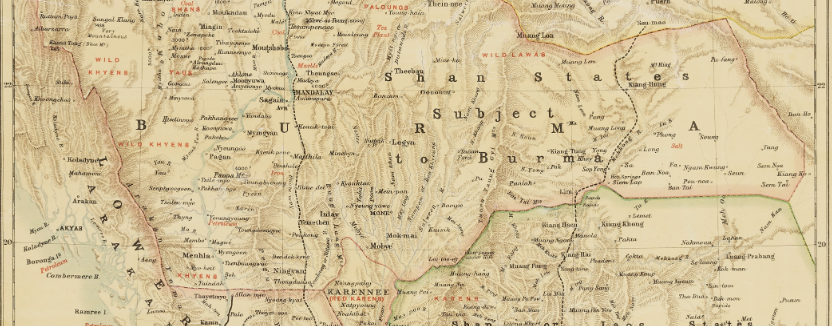
Map of Burma with Parts of India China Siam 1886, via Wikipedia Commons.
Title: Buddhist Internationalism and the World Peace Pagoda: North-South Buddhist Exchange Between Japan and Burma in the Cold War.
Speaker: Anthony Scott (JF-GJS Fellow, Institute for Advanced Studies on Asia, University of Tokyo)
Date and Time: July 17, 2026, 16:00-17:30 (JST)
Venue: Conference Room 2, Institute for Advanced Studies on Asia, University of Tokyo.
Moderator: Norihisa Baba (Professor of Institute for Advanced Studies on Asia, University of Tokyo)
Abstract: The coming together of a Pan-Asian religious infrastructure and the emerging consciousness of being “Buddhist” gave rise to a what I am calling “Buddhist internationalism,” a form of anti-imperial worldmaking in the late 19th and early 20th century. The focus of this paper, I approach Buddhist internationalism through two conferences held in Burma in 1954, the Sixth Council and Third General Council of the World Federation of Buddhists. By exploring accounts in Burmese and Japanese periodicals, my focus is on the delegation sent to Burma by the Japanese Buddhist Federation, an initiative of heritage diplomacy that gave way to a more radical act of internationalism through the creation of the North-South Buddhist Exchange. The members of this exchange eventually built the World Peace Pagoda in Kyushu in the late 1950s, a symbol of Buddhist solidarity that, I argue, challenges many of our prevailing cold war narratives.