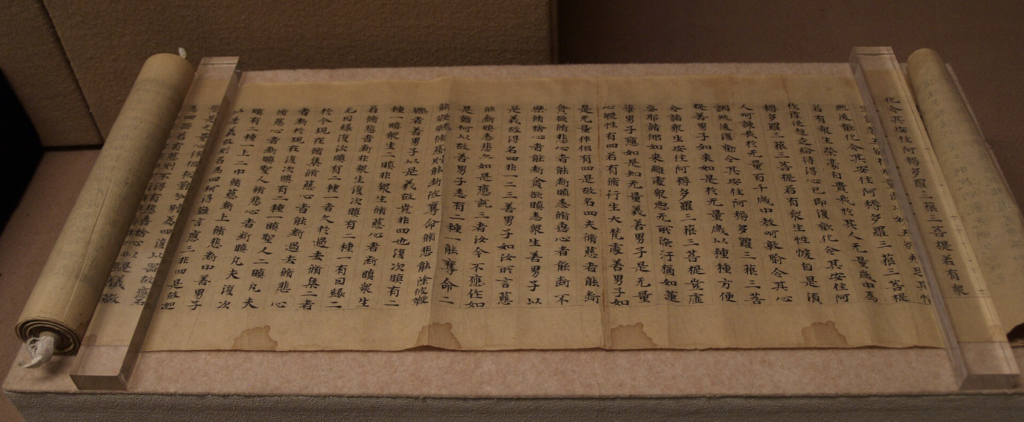
Sui dynasty Mahayana Mahaparinirvana Sutra housed in the Museum of the Mausoleum of the Nanyue King, via Wikipedia Commons.
Speaker: Dr. Bo Pang (Department of Philosophy, Peking University)
Date and time: Monday, April 27, 2026 16:50-18:30
Location: Conference Room 3, Institute for Advanced Studies on Asia, The University of Tokyo
Language: Japanese
Moderator: Mikiyasu Yanagi (Institute for Advanced Studies on Asia, The University of Tokyo)
Abstract: This presentation elucidates the development of dependent origination (pratītyasamutpāda) thought in Jizang (549–623), the great synthesizer of the Chinese Sanlun (Three-Treatise) school, through the lens of his reception of the “Lion’s Roar” chapter in the Nirvana Sutra.
Jizang reinterpreted the Contemplation of Causation Chapter in the Mūlamadhyamakakārikā as a text for contemplating twelvefold causation. In the “Lion’s Roar” chapter of the Nirvana Sutra—a text Jizang held in high regard—twelvefold causation is explained through the “ten negations.” Because these ten negations are conceptually identical to the “eight negations” in Nāgārjuna’s Mūlamadhyamakakārikā, it becomes clear that Jizang used the Nirvana Sutra as a medium to understand the concept of dependent origination in the Mūlamadhyamakakārikā.
Reinterpreting the Nirvana Sutra—which teaches that “all sentient beings possess the Buddhanature”— from the Sanlun perspective of emptiness (śūnyatā), Jizang identified the “Lion’s Roar” chapter with its ten negations as the core of the sutra. Furthermore, in contrast to the Indian Madhyamaka tradition’s tendency toward abstract theoretical inquiry, Jizang’s emphasis on the contemplation of twelvefold causation demonstrates an orientation more closely aligned with practical meditative practice and liberation.
Going beyond the conventional framework of “emptiness,” this study highlights a new dimension and significance of Jizang’s thought from the perspective of his reception of the Nirvana Sutra.