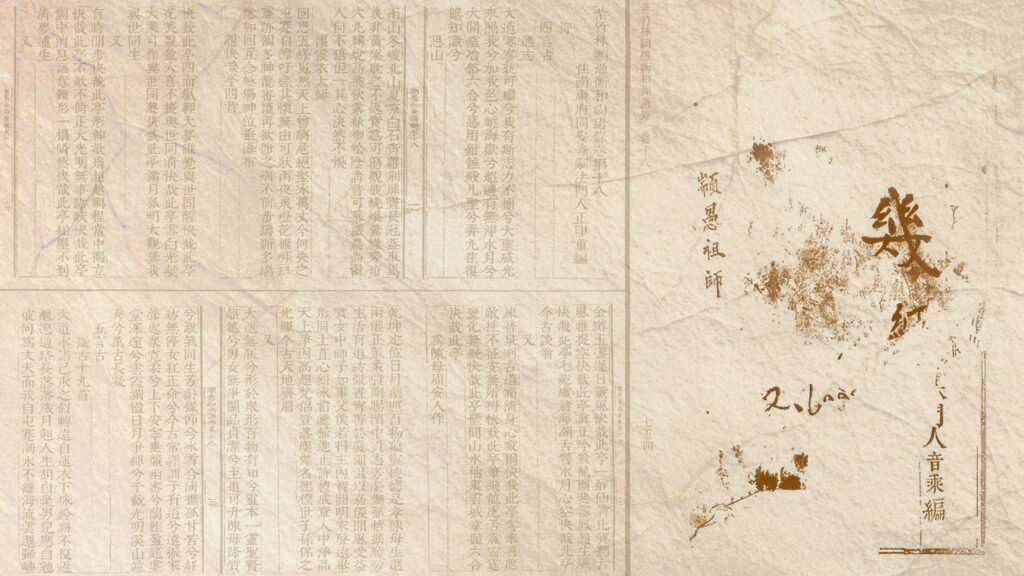
Left: Records of Monk Zhanyu Heng of Purple Bamboo Grove, Volume 28 of the printed Jingshan recension of the Jiaxing Canon. Right: Chronicle of Monk Zhanyu of Wutai, Volume 6 of the Rare Chronicle Series held at the Shanghai Library.
Speaker: Professor Xiaoping Yang (School of Philosophy and Social Development, Shandong University)
Date: Wednesday, November 25, 2025, 10:00 am PCT
Venue: UBC Asian Centre, Room 604
In-person registration: https://ubcfrogbear-yang-enlightenment-within-bodily-affliction.eventbrite.ca/
Zoom registration: https://ubc.zoom.us/meeting/register/VIOJxEJdQlipiP_LbF4xxw
This lecture is presented in Mandarin.
Abstract:
Zhuanyu Guanheng (1579–1646), a prominent late-Ming monk of the Caodong school, received Dharma transmission from Buddhist master and poet, Hanshan Deqing, and was regarded as Hanshan’s foremost disciple. A pivotal figure sustaining the Buddhist lineage from the Wanli era into the early Qing, Guanheng propagated Dharma across Hunan, Jiangxi, and Jiangsu. He served as abbot of four major monasteries, including Yunju Zhenru Temple and Jinling Purple Bamboo Grove. He commanded thousands of followers and was highly respected within the contemporary sangha; Ouyi Zhixu, a Buddhist monk and scholar of the same period, praised Guanheng’s humility and benevolence. Despite his standing among the leading Buddhist masters of the late Ming, Guanheng remains relatively understudied as a “virtuous yet obscure monk”.
The Ming-Qing transition saw the sharp differentiation and reconstruction of monastic identities, often represented by two opposing archetypes: loyalist monks who remained committed to the fallen dynasty and those accommodated to the new regime. Guanheng’s self-fashioning as a “sick monk” transcended this binary. Drawing on his recorded sayings, biographies, local gazetteers, and Buddhist histories, this lecture employs textual cross‑reading and contextual analysis to unpack the genesis and core meaning of his doctrine of “being sick yet not sick”. It examines how his bodily illness shaped his Dharma practice and existential choices, tracing his unique path of toward a monastic identity and addressing gaps in current scholarship.
About the speaker:
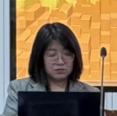
Xiaoping Yang is an Associate Professor in Religious Studies at the School of Philosophy and Social Development, Shandong University. She received her PhD from Renmin University of China and pursued studies in Japan. Her research covers Huayan, Chan, and Japanese Buddhism. Her publications include “Dharmadhātu in the Fajing Lun” (2025), “A Study on the Origin of Chinese Huayan Thought: Focusing on the Doctrine of Dharmadhātu of Lingbian’s Huayan Jinglun” (2024), and “Wuxin and Xiaoyao: Tanqian’s Wang Shifei Lun in the Perspective of Chinese Thought History” (2024).


