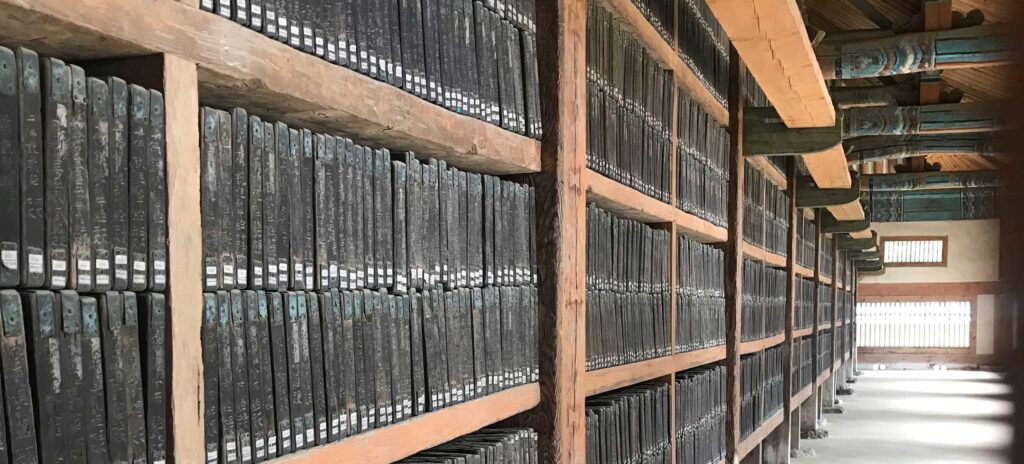
Hapch’ŏn Haeinsa taejanggyŏngp’an (陜川海印寺大藏經板), Korea. FROGBEAR Cluster 2.2, 2019. Yohong Roh.
“Translation across the Four Directions”: Buddhist Translation Institutions, Canon Formation, and the Translingual Shaping of Asian Civilizations
Organizers: Glorisun Global Network for Buddhist Studies; Peking University Center for Buddhist Texts and Art Research
Co-organizer & Host: Mount Kuaiji Academy; Mount Kuaiji Advanced Institute of Buddhist Studies
Date: July 7–10, 2026
| Abstracts | Panelists | Schedule | Reports |
The Glorisun Global Buddhist Studies Network and Peking University Center for Buddhist Texts and Art Research, in cooperation with partner universities and hosted by the Mount Kuaiji Advanced Institute of Buddhist Studies, are pleased to announce an international conference:
“Translation across the Four Directions”: Buddhist Translation Institutions, Canon Formation, and the Translingual Shaping of Asian Civilizations.
This conference will take place from July 7 (arrival) to July 10 (departure), 2026, at Mount Kuaiji Academy, Shaoxing 紹興, Zhejiang Province.
Aim and Scope
Translation has historically served as a central mechanism of civilizational exchange rather than a mere technical skill. In imperial China, official translators were embedded in governance and diplomacy; beyond these state systems, Buddhist translation institutions—beginning with Kumarajiva (344–413 CE)—developed highly organized translation workshops. These centers not only transmitted texts but created collaborative, cross-cultural intellectual communities, linking India, Central Asia, China, Korea, and Japan.
This conference seeks to revisit the formation and development of Buddhist texts—especially Chinese translations—and examine how multilingual translation processes shaped the spread of Buddhism and functioned as media for broader cultural transmission. Buddhist translation institutions exemplify how ideas, practices, and institutions collectively shape civilizations.
Significance of Ancient Translation Workshops
The success of ancient Buddhist translation institutions can be summarized in four aspects:
- Structured Division of Labor: Translators, copyists, proofreaders, and editors collaborated in highly institutionalized workflows to ensure text quality.
- Collaborative Multilingual Engagement: Teams brought together scholars from diverse linguistic and cultural backgrounds, enabling accurate semantic transfer.
- Talent Cultivation and Intellectual Resonance: Workshops functioned as knowledge communities and incubators of new thought.
- Sustainable Funding and Public Participation: State sponsorship and lay patronage ensured continuity, embedding translation in societal and civilizational structures.
Translation, in this context, generated not only texts but ideas, institutions, and civilizational ethos.
Methodological Innovation
The conference encourages approaches that combine multiple disciplines and methods:
- Interdisciplinary research integrating philology, linguistics, intellectual history, and institutional history.
- Digital humanities and computational methods for textual comparison, terminology mapping, and translation pattern analysis.
- Comparative translation studies and historical semantics to track concept formation across languages.
- Positioning Buddhist translation within global translation history, alongside classical and medieval translation movements worldwide.
Contemporary Relevance
Translation functions as both a bridge for civilizational exchange and a workshop for intellectual creation. Historical experience shows that when translation institutions thrive, civilizations exhibit openness, inclusivity, and dynamism; when they decline, cultures tend toward closure and self-sufficiency.
The ancient expression “Ji–Xiang–Di–Di” 寄象狄鞮 (Lit: Translation across the Four Directions) symbolizes more than foreign language—it represents the path of civilizational communication. This conference aims to reconstruct a model of translingual and cross-cultural dialogue, offering new perspectives for the study of Asian civilizations and global translation history.
Key Topics
We invite papers addressing but not limited to the following areas:
- Historical and contemporary processes of Buddhist canon formation.
- Oral transmission and textualization of Buddhist scriptures.
- Chinese Buddhist translations and the development of the Chinese Tripitaka.
- The role of Buddhist translation in transregional civilizational exchange.
- Textual authenticity, pseudo-texts, and local creative adaptations.
- Conceptual transformations and intellectual history of translated terms (e.g., śūnyatā, tathāgatagarbha, bodhi).
- Historical lessons and contemporary implications for translation and cross-language scholarship.
- Media and Message: Buddhist translation institutions as nodes of knowledge production and information dissemination.
Participation and Submission
- All participants’ accommodation and meals during the conference will be provided.
- Partial travel subsidies may be available depending on funding.
- Conference proceedings (in Chinese and English) are planned.
- Scholars who can submit full papers by mid-June 2026 (draft) and mid-October 2026 (revised) are encouraged to apply.
Deadline for abstract submission: April 15, 2026
Email: frogbear.project@ubc.ca
This conference is part of the annual Glorisun International Intensive Program on Buddhist Studies.
Participants of early career are additionally welcome to attend:
- The The Inaugural World Young Sinologists Summer Institute (organized by The Baiqian Initiative and hosted by Yenching Academy of Peking University) and;
- The symposium “New Materials and New Perspectives in Asian Civilization Studies” (hosted by the Center for Buddhist Civilization Studies at Zhejiang University and the Glorisun Global Network for Buddhist Studies).


