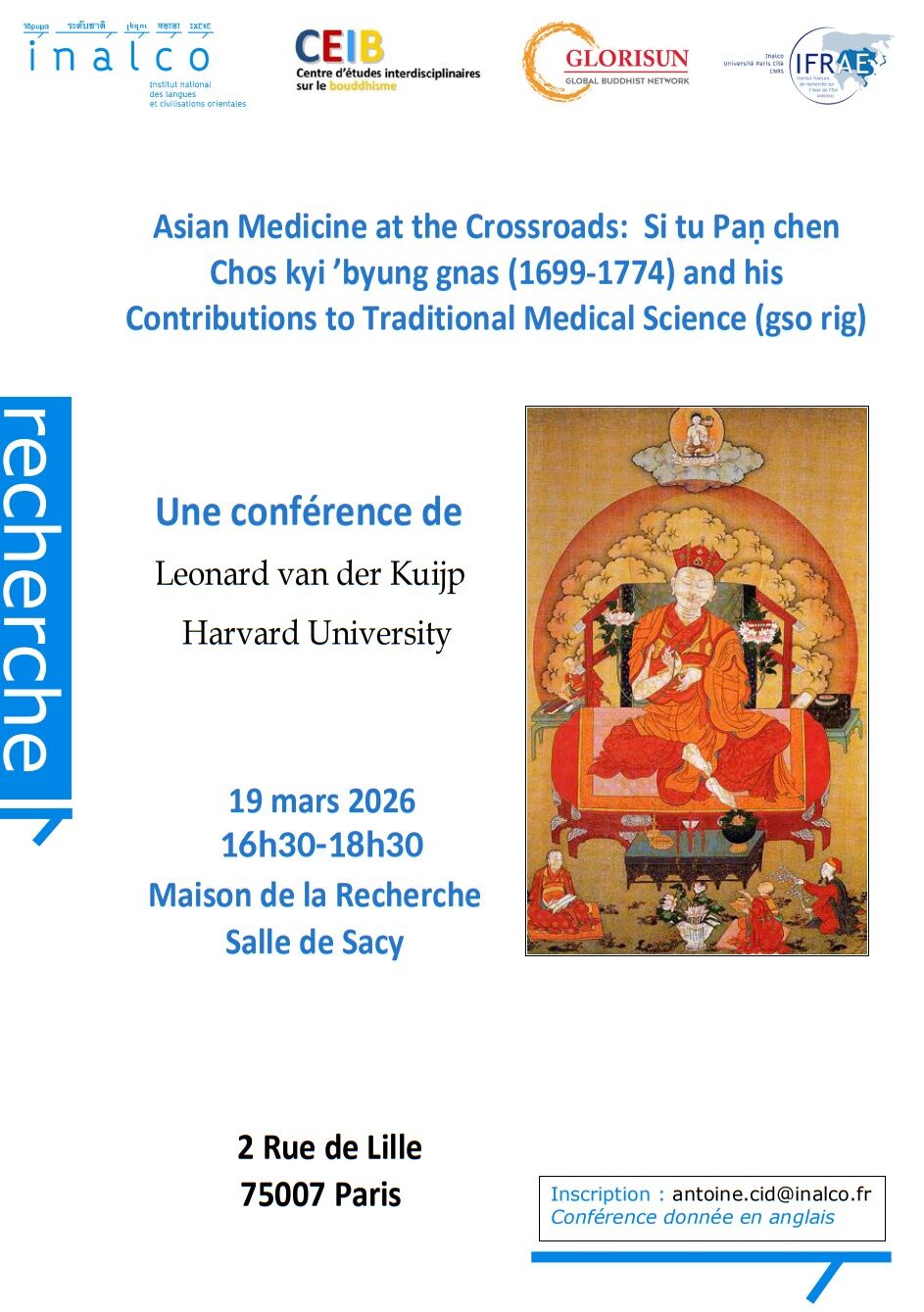
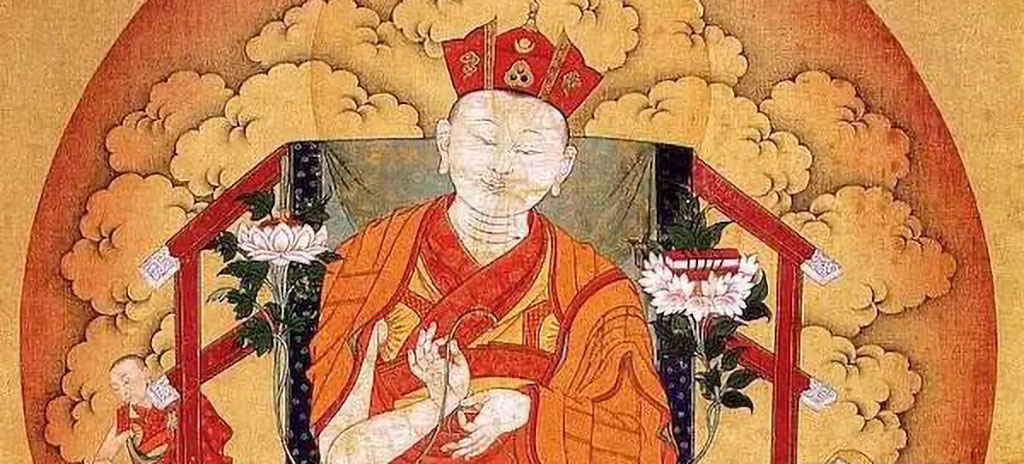
Detail of Situ Panchen 8, Chokyi Jungne, Museum der Kulturen, Basel.
Speaker: Leonard van der Kuijp (Endowed Professor of Tibetan and Himalayan Studies, Harvard University)
Date and time: Thursday, March 19th, 4:30 PM (Paris)
Location: Inalco, Maison de la Recherche, Salle de Sacy (2 rue de Lille, 75007 Paris)
Abstract: Born, if not with a golden spoon in his mouth, then at least with a silver one, Si tu (< Ch. situ 司徒) or Ta’i si tu (< Ch. dasitu 大司徒) Paṇ chen was no doubt the most versatile Tibetan scholar of the eighteenth century and arguably the greatest intellectual active during this period in what is now Sichuan Province, PRC. His recognition as a re-embodiment in the Karma Bka’ brgyud pa lineage of the Si tu/Ta’i si tu series was not immediate and was by no means uncontroversial. Nevertheless, his eventual recognition proved to be a fortunate choice. Si tu Paṇ chen’s intellectual versatility and the breadth of his learning were in part predicated on his talent for languages. These included Sanskrit, probably Newari/Nepali, Chinese, probably Naxi as well, and some Mongolian. Except for Newari/Nepali, these languages gave him access to the principles of both Indic Ayurveda and Chinese medicine. His collected oeuvre contains translations of Chinese treatises dealing with the treatment of smallpox and the use of medicinal substances. He was also something of a herbalist, and his writings—as well as those of the students inspired by him—testify to his/their knowledge of herbal medicine. In addition to writing on medicine per se, he also compounded his own medicines and even maintained a kind of dispensary through which he distributed his remedies far and wide.

Bionote: Leonard W.J. van der Kuijp is Professor of Tibetan and Himalayan Studies and chairs the Committee on Inner Asian and Altaic Studies. Best known for his studies of Indo-Tibetan Buddhist thought, he is the author of numerous works. Recent publications include Handbook of Tibetan Iconometry. A Guide to the Arts of the 17th Century [with Chr. Cüppers, Ulrich Pagel, and Dobis Tsering Gyal] and Bcom ldan ral gri (1227-1305) on Buddhist Epistemology and Logic: His Commentary on Dignāga’s Pramāṇasamuccaya [with A. McKeown]. Van der Kuijp’s research focuses on Indo-Tibetan Buddhist thought, Tibetan Buddhist intellectual history, Tibetan cultural history, and premodern Sino-Tibetan and Tibeto-Mongol political and religious relations. In 1993, van der Kuijp received the MacArthur Fellowship, was the recipient of a Guggenheim Fellowship in 2016, and was, in 2018, inducted in the Royal Netherlands Academy of Arts and Sciences. Van der Kuijp worked at the Nepal Research Center, Kathmandu, the Freie Universitāt, Berlin, and the University of Washington, Seattle. In 1999, he assisted E. Gene Smith in founding the Tibetan Buddhist Resource Center (TBRC), now the Buddhist Digital Resource Center (BDRC).
Download the original lecture poster here.