
CALL FOR PAPERS
Enduring Discoveries of the Cosmopolitan, Multicultural, Expansive and Relative Orthodoxies in the Study of East Asian Buddhism, History, Manuscripts, Archaeology, Literature, Art, and East-West Exchanges
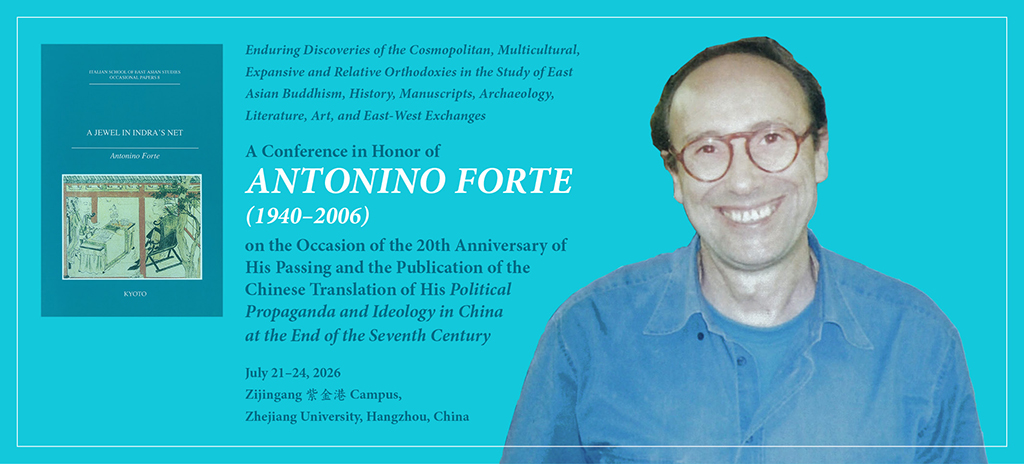
A Conference in Honor of Antonino Forte (1940–2006) on the Occasion of the 20th Anniversary of His Passing and the Publication of the Chinese Translation of His Political Propaganda and Ideology in China at the End of the Seventh Century
July 21–24, 2026
Zijingang 紫金港 Campus, Zhejiang University, Hangzhou, China
| Abstracts | Panelists | Schedule | Reports |
The Glorisun Global Network for Buddhist Studies, with the assistance of Zhejiang University Research Center for Buddhist Civilization 浙江大學佛教文明研究中心 in Hangzhou, China and the FROGBEAR Project (frogbear.org) based at the University of British Columbia, Vancouver, Canada, cordially invites proposals for an international conference. The conference is to honour the remarkably enduring influence of Antonino Forte (1940.08.06–2006.07.22) upon the fields of Buddhist studies, medieval Chinese and Japanese history, Silk Road studies, East Asian art and archaeology, and beyond in North America, Europe, Oceania, Japan, Korea, and China. Characteristic of Professor Forte and his work, the “Enduring Discoveries of the Cosmopolitan, Multicultural, Expansive and Relative Orthodoxies in the Study of East Asian Buddhism, History, Manuscripts, Archaeology, Literature, Art, and East-West Exchanges” conference will be a unique tripartite confluence: geographically cross-regional, and thematically as cross-cultural, cross-religious, and interdisciplinary as possible, as amply demonstrated by a comprehensive list of publications by Antonino Forte (“Antonino Forte – List of Publications,” JIABS 30.1–2 (2007 [2009]): 17–31), carefully prepared by Erika Forte.
Known to his many friends, teachers, and students as “Nino”, especially at the ISEAS in Kyoto, Japan, Professor Forte’s scholarship changed the way we—across the globe—think, research, and teach about the medieval world in Asia. He relished every opportunity to utilize archaeological discoveries in multiple languages from Chinese Central Asia, and particularly the cache of manuscripts found near Dunhuang at the turn of the 20th century, to rewrite the narrative of the history of the Buddhist religion in medieval China, Central Asia, and Japan. Moreover, his meticulous attention to critical analysis of sources transformed the way anyone studies Chinese history. It is difficult to imagine any undergraduate student who takes a course in the disciplines of Chinese or Japanese history, or Buddhist or Asian studies is not exposed to the fruits of Prof. Forte’s outstanding and enduring research. His investigations ranged from apocryphal or Buddhist texts composed or compiled in China, to those translated from Indic languages, colossal edifices, and a clock. He examined powerful personalities who shaped the enigmatic age of Empress Wu Zetian 武則天 (624–705), and pursued the case of a 2nd century Iranian prince held hostage in China. He explored the multifaceted translation processes from Indic languages into Chinese and Japanese, manuscripts from Dunhuang and Nanatsudera (in Japan), as well as researched science, architecture, Daoist and religious studies, art and iconography in medieval China and Japan. As a member of the École Française d’Extrême Orient (EFEO) in Kyoto from 1976 to 1985, and as director of the Italian School of East Asian Studies, Prof. Forte contributed much more than merely his own research. He also dedicated ceaseless time and attention to editing and contributing entries to Hōbōgirin 法寶義林: Dictionnaire encyclopédique de bouddhisme d’après les sources chinoises et japonaises with Paul Demiéville (1894–1979), Anna Seidel (1938–1991), and his close friend Hubert Durt (1936–2018). Prof. Forte’s expert guidance led to the publication of numerous groundbreaking monographs by the Italian School of East Asian Studies. Prof. Forte played a seminal role in introducing a generation of junior and senior scholars from around the world to leading experts in Japan including, but not limited to, Makita Tairyō 牧田諦亮 (1912–2011) and Yanagida Seizan 柳田聖山 (1922–2006). Perhaps the most enduring contribution Prof. Forte made was to inspire others to follow his lead to track down as many—archaeological and manuscript—sources as possible about a given topic, critically assess received, edited documents, and question the veracity of geographical, doctrinal, historiographical, and disciplinary boundaries.
Not merely a devoted scholar, Prof. Forte was also a keen promoter of international education. His work benefitted a number of younger scholars around the globe. In addition to being an inspiring mentor, he is also fondly remembered as a caring friend. He endeavoured to boldly break down boundaries he perceived might prevent the enhancement of scholarship or hinder communication among different cultures and peoples. This barrier-shattering desire must have underlain his heroic effort to establish and maintain for so many years the ISEAS in Kyoto, a heaven and haven for so many international students of East Asian Studies and Buddhology working in Kyoto.
The organizing committee welcomes paper proposals related to any aspect(s) of the multidisciplinary, inter-cultural, and cross-regional study of these three research areas. Priority will be given not only to proposals from scholars who have had interaction with Prof. Forte either in person or through work during his prolific life, but also to emerging scholars who, though not in direct dialogue with Prof. Forte, are influenced by or have responded to his research. All conference-related costs, including local transportation, meals and accommodation during the conference period, will be covered by the conference organizers, who—depending on availability of funding—may also provide a travel subsidy to selected panelists who are in need of funding.
The conference organizers will collect all the papers to produce volumes dedicated to the enduring legacy of Forte. Only scholars who are confident in finishing their draft papers by the middle of July and submitting revised and publishable papers by the end of October are encouraged to apply.
Please email proposals and CVs to FrogBear.Project@ubc.ca and liu9637@foxmail.com by May 15 (Friday), 2026.


