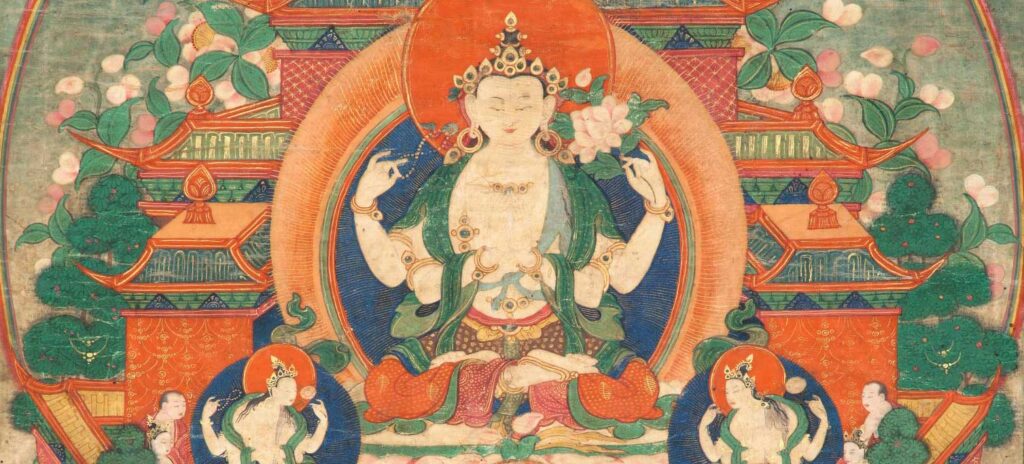
Avalokiteshvara in his Potala Pure Land; Tibet; late 18th–early 19th century; Pigments on cloth, silk brocade, cotton backing; Rubin Museum of Himalayan Art, Gift of Shelley and Donald Rubin; C2012.4.5, via Rubin Museum.
Date and Time: Tuesday, November 17th, 2026, 7:00-9:00 pm (Hong Kong Time)
Speaker: Dr. Yao Shuang (Assistant Professor, Renmin University of China)
Venue: CPD 3.04, 3/F, Run Run Shaw Tower, Centennial Campus, The University of Hong Kong
Title: Seeking Potalaka: Avalokiteśvara’s Sacred Mountain in Chinese and Tibetan Buddhism
Abstract:
According to the Avataṃsaka Sūtra, the bodhisattva Avalokiteśvara dwells on Potalaka, a mountain beside the southern sea. Yet across Asia many places have claimed that name, from the Pothigai Hills of South India to Mount Putuo in Zhejiang, the Potala Palace in Lhasa, the Putuo Zongcheng Temple in Chengde, Fudarakusan-ji in Japan and Naksansa in Korea. How did one mountain in a scripture come to have so many sites on earth, and what happened when these sacred places met? This lecture begins with how Tibetan Buddhists came to know po ta la, then follows Potalaka through Chinese and Tibetan scriptures, travel accounts and local gazetteers to show how the two traditions built, contested and came to recognize Avalokiteśvara’s abode. It argues that sacred sites are made as well as found, taking shape through encounters across languages, regions and political worlds. The history of Potalaka offers a window onto the long entanglement of Chinese and Tibetan Buddhism.
Organizer: HKU Centre of Buddhist Studies
Sponsor: GS Charity Foundation
Speaker:
Dr. Yao Shuang is an Assistant Professor in Comparative Literature at the School of Liberal Arts, Renmin University of China. She holds a PhD from Tsinghua University, an MSc in Art in the Global Middle Ages from the University of Edinburgh and a BA from Beijing Foreign Studies University, and was a Shuimu Tsinghua Scholar postdoctoral fellow at Tsinghua’s Institute for Advanced Study in Humanities and Social Sciences (2021–2023). Trained in Tibetan and Buddhist philology and art history, she works on comparative Sino-Tibetan Buddhist studies, Tibetan monastic art and traditional writings on the arts. She co-edited What Is Philology? (2021), and is an experienced translator and interpreter who has translated exhibition catalogues for the Palace Museum, Beijing.