
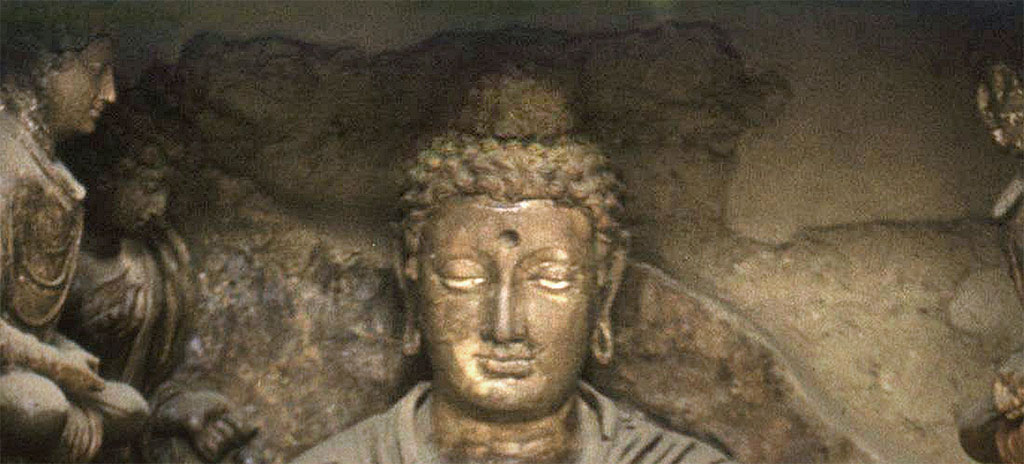
The Buddha, Tapa Shotor monastery in Hadda, Afghanistan (Niche V1), 2nd century CE, via Wikipedia Commons.
Conference: Conversations with the Sarvāstivāda Abhidharma
Venue: Institute for Advanced Studies on Asia, The University of Tokyo 東京大学東洋文化研究所大会議室
Date: April 25th, 2025, 13.00-18.00
Program
13.00-14.00: Keynote Lecture
Matsuda Kazunobu 松田和信 (Professor Emeritus, Bukkyo University)
Meaning of the Dharma in the Three Refuges as Seen in Abhidharmakośa and Tridaṇḍamālā
14.00-15.00
Mingyuan Gao 高明元 (Research Fellow, Faculty of Letters, Arts and Sciences, Waseda University)
Thus Have the Buddha’s Teaching Been Heard: On the Abhidharmic Sources of Śrutavāsanā
15.00-15.30: Break
15.30-16.30:
Henry Albery (JSPS Postdoctoral Fellow, Institute for Advanced Studies on Asia, The University of Tokyo)
“Bodhisattva Vaibhāṣika”: theory and practice in the yoga manuals of Central Asia
16.30-17.30
Jason Browning (visiting scholar, IASA, University of Tokyo)
Early Mediaeval Central Asian Abhidharma as Non-Factionalized Scholastic Philosophy: The Evidence from Contemporaneous Islamic Texts
17.30-18.00: Discussion
Dadigo Isshiki 一色大悟 (Associate Professor, University of Tokyo)
Abstracts
Matsuda Kazunobu
Meaning of the Dharma in the Three Refuges as Seen in Abhidharmakośa and Tridaṇḍamālā
The Dharma of the Three Refuges (Triśaraṇa) is usually understood as the “Buddha’s teachings.” But is that understanding really accurate? In this talk, I’ll explore this question by looking at a lesser-known Sanskrit text called the Tridaṇḍakamālā—a collection of forty recitation scriptures attributed to Aśvaghoṣa and preserved in the Sarvāstivāda Buddhist order. Based on my reading of this text, I’ll argue that in the Sarvāstivāda context, the Dharma of the Three Refuges wasn’t seen as “the Buddha’s teachings,” but rather as Nirvāṇa itself.
Mingyuan Gao
Thus Have the Buddha’s Teaching Been Heard: On the Abhidharmic Sources of Śrutavāsanā
Asaṅga’s Mahāyānasaṃgraha speaks of śrutavāsanā as the impression of hearing the Buddha’s true Dharma. The śrutavāsanā is said to be the cause of the supramundane purification, being contradictory to the three types of defiled vāsanā in the ālayavijñāna. A question should be raised as to why the cause of the supramundane uncontaminated dharma is called “śrutavāsanā”, which stresses the significance of hearing. I would like to suggest that one doctrinal origin of śrutavāsanā is the Sarvāstivāda doctrine of mokṣabhāgīya. According to the Sarvāstivādins, when hearing the Buddha’s Dharma, mokṣabhāgīya kuśalamūla is planted in one’s mind. Having mokṣabhāgīya kuśalamūla means that one has obtained the certainty of attaining parinirvāṇa. Mokṣabhāgīya is śruta-cintā-maya but not bhāvanā-maya. Though mundane, mokṣabhāgīya is anti-saṃsāric and can bring forth a supramundane result. The depiction of gotra in the Śrāvakabhūmi of the Yogācārabhūmi shows a close resemblance in wording to the Sarvāstivādins’ definition of mokṣabhāgīya, though the term does not occur in the Yogācāra context. The Mahāyānasūtrālaṃkāra associates hearing (śruta) the Dharma at the initial stage of practice with vāsana. The related description also resembles the Sarvāstivādins’ definition of mokṣabhāgīya. Moreover, Asaṅga’s discussion about śrutavāsanā as the cause of the initial supramundane purification in the Mahāyānasaṃgraha also bears a theoretical similarity to mokṣabhāgīya.
Henry Albery
“Bodhisattva Vaibhāṣika”: theory and practice in the yoga manuals of Central Asia
There is much today that remains unclear about the text Dieter Schlingloff (2006) styled Ein buddhistisches Yogalehrbuch (a Buddhist yoga manual). No colophon is preserved in what little is left of the manuscript and so its title, authorship and a good deal of its contents remain quite the mystery. We know the work enjoyed some popularity in Central Asia around the 7th century, with several Sanskrit versions circulating in the region of Kučā on the northern rim of the Tarim Basin. And its author was most likely a practitioner of yoga (yogin, yogācāra), a Bodhisattva by purpose and Sarvāstivādin by doctrine, whose journey through the vistas of meditation the text so vividly describes, with its 15 practices (prayoga), doctrine and cosmology all drawn from the teachings of that school. Several elements have nonetheless proved more troublesome to define, leading some to suggest a Mahāyāna, Yogācāra or Tantric influence; a rather colourful medley of attributions, which reflects the perplexities the text presents and our inability to fully untangle them. It has now become quite clear, however, that the Yogalehrbuch is intimately related to the *Vibhāṣā, with several correspondences to be found in all three Chinese translations of that work. Most compelling among these are series of formulae found in prefaces to the four immeasurables (apramāṇa), which reflect the precise idiom as the *Vibhāṣā and serve to detail a metaphysics of each. This suggest the author was citing from such a work like the *Vibhāṣā, albeit not from any known to us today, as none its witnesses are quite the same. This work was clearly central to the authorship of the Yogalehrbuch, presumably orienting the practice of yoga it primarily serves to illustrate. Addressing these points, this presentation is an initial attempt at a partial reading of the conversation that occurred between the author of the Yogalehrbuch and the *Vibhāṣā on the subject of the four immeasurables. These practices are also conspicuous in the text as whole, for it is in their passages that the climax of the drama unfolds, with an unveiling of the ultimate purpose of yoga and awakening of a Bodhisattva Vaibhāṣika.
Jason Browning
Early Mediaeval Central Asian Abhidharma as Non-Factionalized Scholastic Philosophy: The Evidence from Contemporaneous Islamic Texts
Both traditional Buddhist commentators and modern scholars have often portrayed various Buddhist philosophers as adhering strictly to one philosophical ‘school’ or another. Such designations are frequently contentious, since in numerous cases a given Buddhist philosopher can be argued to have been strictly affiliated with a number of competing philosophical ‘schools’. To be sure, there have been cases of outright, staunch assertions of factionalism among Buddhist philosophers themselves— Saṃghabhadra’s vehement denunciations of Vasubandhu’s Abhidharmakośa-bhāṣya is perhaps the best case in point. However, modern scholars are beginning to take more notice that such staunch factionalism was more of an exception than a norm among Buddhist philosophers from Antiquity through the Early Middle Ages. In this presentation I suggest that Sarvāstivāda ābhidharmikas were no different: some (such as Saṃghabhadra) reinforced a staunch factionalism, while most (from varying Sarvāstivāda ‘schools’) utilized philosophical concepts and principles from other Sarvāstivāda ‘schools’, from other Buddhist philosophical schools more generally, and even from outside the Buddhist tradition. Using the history of the transmission of Sarvāstivāda atomistic theories to the first Islamic theologians (and thus to the first Islamic atomists), I suggest that the abhidharma that Islamic theologians received demonstrates that, at least, early medieval Central Asian Sarvāstivāda philosophy was much more complex and non-factionalized than modern scholars generally recognize.


