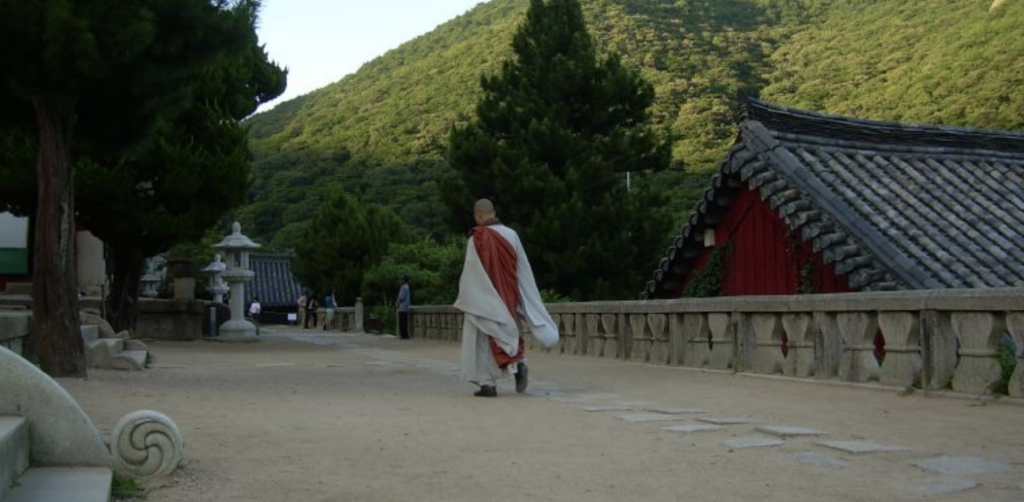
Korea-Busan-Beomeosa-Monk-01. via Wikimedia Commons.
Speakers: Hwang Soonil and Ven. Chongdok (Dongguk University)
Date: Monday 26 October 2026
Basement Teaching Room 1 at 5:00pm
Faculty of Asian and Middle Eastern Studies
Pusey Lane, Oxford, OX1 2LE
All Welcome
Tea and snacks at 4:30–4:50pm (Common Room in the basement)
All enquiries: yuling.wu@balliol.ox.ac.uk
Glorisun Lecture Series in Buddhist Studies, Michaelmas Term 2026
Kindly supported by the Glorisun Global Network for Buddhist Studies.
This lecture features two presentations by scholars from Dongguk University examining the profound demographic transformation facing contemporary Korean Buddhism. Together, the talks address the dual structural challenges shaping the future of the Sangha: (1) the sharp decline in new monastic recruitment amid secularization and low birth rates, and (2) the growing institutional demands of providing eldercare and retirement support for an ageing monastic population.
Abstracts:
“Fewer Becoming: Secularization, Low Birth Rates, and the Changing Sangha in Korea”
Soonil Hwang (Dongguk University)
The decline of Buddhist monastic recruitment in contemporary South Korea reflects a broader transformation in the social conditions through which the Buddhist Sangha reproduces itself across generations. This presentation examines the sharp decline in recruitment within the Jogye Order since the late 1990s and relates it to demographic contraction, declining fertility, smaller families, generational religious disaffiliation, geographical redistribution, and the weakening of traditional religious networks. Particular attention is given to the growing mismatch between the geographical and generational distribution of the Buddhist population and that of younger Koreans from whom future monastics must be recruited. The presentation argues that the Korean problem is not simply a reduction in the number of potential recruits, but a transformation of the social pathways through which Buddhism is transmitted. A brief comparison with Taiwan and Japan highlights alternative forms of institutional adaptation to demographic and generational change. The presentation concludes by considering how Korean Buddhism might develop new forms of engagement that move from inherited religious identity toward voluntary experience, practice, and community, and how such changes may reshape the future reproduction of the Sangha.
“Old Age, Sickness & Death: Buddhist Monastic Retirement & Eldercare Within South Korea’s Super-Aged Society”
Ven. Chongdok (Dongguk University)
As the Buddhist monastic community in Korea has entered an era marked by ageing demographics, the issues surrounding the welfare of the order’s monastics in their retirement years have become increasingly pressing. In response, in 2011, the Jogye Order enacted the Monastic Welfare Act and established the Monastic Welfare Society with the aim of enabling monks to fully devote themselves to their religious duties by assuming institutional responsibility for their healthcare, pension, residential welfare, and end-of-life needs. Over a decade since the system’s implementation, the Jogye Order has made notable progress towards achieving the Monastic Welfare Act’s aims. However, while the order has stabilized medical coverage for its clergy, there remain considerable gaps in its provisions for income and housing for elderly monastics. This presentation surveys the Jogye Order’s efforts to establish systemic care for its elderly monastics, with a particular focus on the Jogye Order’s 2011 Monastic Welfare Act and subsequent activities of the Monastic Welfare Society. It then critically examines the current state of eldercare within the order, along with its strengths and weaknesses, before engaging in a comparative discussion regarding the clerical eldercare and welfare systems provided by both the Korean Catholic Church and the Thai Buddhist community.
Speakers:
 Dr. Soonil Hwang is a Professor in the College of Buddhist Studies at Dongguk University, Seoul, South Korea. His primary research interests include the doctrinal history of Early Buddhism and the study of Buddhist culture in South and Southeast Asia. He earned his DPhil from the University of Oxford, specialising in the doctrinal history of nirvāṇa in Indian Buddhism. Dr. Hwang has held visiting professorships at Al-Farabi Kazakh National University (2011), Chulalongkorn University (2012), and Saitama University (2013). His notable publications include Metaphor and Literalism in Buddhism (Routledge, 2006), Sermon of the One Hundred Days (Equinox, 2010), and Advent of Theravāda Buddhism into Southeast Asia (Gasan Institute, 2018). He is a recipient of the Bulyi Academic Award (2008) and the SBS Seoam Fellowship (2011). An experienced administrator, Dr. Hwang has served as the Dean of Academic Affairs and as Director of EBTI and Cultural Content at Dongguk University. Following a five-year term as Dean of the College of Buddhist Studies (2020–2024), he completed a sabbatical as an external lecturer at the University of Salzburg, Austria, in 2025, before returning to his professorship at Dongguk University.
 Ven. Prof. Chongdok (Cheonghwan Park) is a Professor in the College of Buddhist Studies and Director of the Buddhist Culture Research Institute at Dongguk University in Seoul, South Korea. He received his DPhil degree in Buddhist Studies from the University of Oxford in 2005 based on his dissertation entitled “A Translation and Study of Selected Avadānas of the Mūlasarvāstivādin Vinaya (MSV).” His main research interest is Buddhist narrative. Recently, his research has also focused on contemporary Korean Buddhism. His publications include “An Analysis of the Image of Women in the Mallikāvadāna of the Mūlasarvāstivādavinaya Kṣudrakavastu (MSVKv)” (2006), A Study on the Avadāna(2006), “A Study of the Concept of the Buddha through the Idea of the Pubbakammapiloti in Theravāda Buddhism (I)” (2006), “A Study on the Buddhist Folktale: Two Nāgas and King Bimbisāra” (2008), “A Study on the Narrative of the Śākyas’ Massacre by Virūḍhaka in the Mūlasarvāstivādavinaya Kṣudrakavastu” (2012), “The Buddha’s Eating of Horse-Fodder Barley in the Mūlasarvāstivādavinaya” (2012), and “A Study on the Narrative of Apalāla in the Mūlasarvāstivādavinaya Bhaiṣajyavastu” (2014). His recent articles on contemporary Korean Buddhism, published in the A&HCI-indexed journal Religions, include “Some Contemporary Dilemmas of Korean Buddhism: A Critical Review of the Jogye Order’s 2018 Periodic Report” (2019), “A Survey of the Attitudes Concerning the Role of the Laity in Korea’s Jogye Order” (2019), and “Glorifying the Order and Creating Great Monks: A Critical Survey of Oral History within the Field of Modern Korean Buddhist Historical Studies” (2026).


