Return to main conference page.
Return to main reports page.
Posted on
By Mingjun JIN, Sichuan University
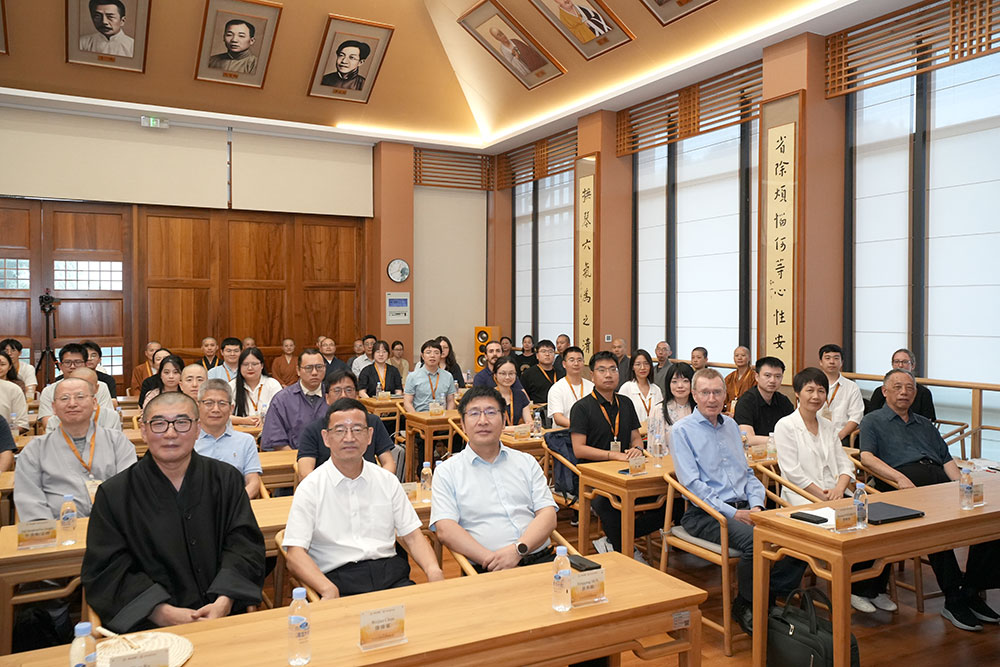
From July 7 to 10, 2026, the international symposium “Translation across the Four Directions”: Buddhist Translation Institutions, Canon Formation, and the Translingual Shaping of Asian Civilizations was held at Mount Kuaiji Advanced Institute for Buddhist Studies in Shaoxing, Zhejiang. The symposium was hosted by the Glorisun Global Network for Buddhist Studies (Peking University) and the Peking University “One Thousand Books in One Century” Project, co-sponsored by the College of Asian Civilizations at Zhejiang University, and hosted by the Mount Kuaiji Advanced Institute for Buddhist Studies in Shaoxing. Scholars from universities and research institutions in China and abroad gathered to discuss Buddhist translation institutions, canon formation, textual transmission, ritual practice, and conceptual transformation.
The conference program was comprised of a keynote speech and six panels: “Language, Philology, and Translation Studies”; “Buddhist Texts, Manuscripts, and Digital Philology”; “Canon, Ritual, and Buddhist Practice”; “East Asian Transmission and Cultural Transformation”; “Translation, Translation Teams, and Buddhist Knowledge Networks”; and “Buddhist Thought and Conceptual Transformation.” Together, the presentations examined translation not simply as a linguistic operation, but as a formative mechanism in the production of Buddhist texts, practices, institutions, and transregional intellectual networks.
Venerable Professor Ru Zhan’s keynote speech. Republished with permission.
Language, Philology, and Translation Studies
Panel 1, “Language, Philology, and Translation Studies,” featured five speakers. HE Rong of the Chinese Academy of Social Sciences presented “A Semantic Study of ‘li’ 力 in Chinese Buddhist Scriptures: With Reference to Modern Works of Taixu.” She traced how the familiar Chinese word li became associated with imported Buddhist vocabulary and formed new concepts such as karmic force and the ten powers. With reference to Taixu’s writings, she further considered the increasingly rich semantic and functional roles of li as a suffix in the circulation of modern knowledge.
DING Yi (Allan) of DePaul University delivered “Meaning, Logic, and Coherence—Revisiting li 理 and daoli 道理 in the Translations of Dharmarakṣa, Paramārtha, and Xuanzang.” He argued that li and daoli in medieval Chinese Buddhist translations did not function as fixed, overarching metaphysical categories. Translators instead deployed them pragmatically to render a range of polysemic Indic terms. A comparison of translations from different periods also showed the growing frequency of these expressions after the fifth century and highlighted the flexible strategies employed by medieval translators.
LI Bohan of The Chinese University of Hong Kong, Shenzhen, examined “The ‘NP suo’ Structure in Chinese Translations of Buddhist Scriptures.” He explained that the frequent locative construction originated in the translation of the Sanskrit phrase “yena NP tena,” indicating the place where NP was located. Beginning in the period of Kumārajīva, the “yu NP suo” construction used with non-motion verbs gradually became fixed and developed into a formulaic expression by the time of Xuanzang, demonstrating the influence of Buddhist translation on the evolution of medieval Chinese syntax.
HOU Xiaoming of Ghent University presented “Where Meditation and Wisdom Converge: The Translation and Conceptualization of sīzé 思擇 and niànhuì 念慧.” By reconstructing the translation histories and conceptual development of the two terms, she showed how, by the late sixth century, they had come to designate a hybrid field of practice linking meditative cultivation with scriptural exegesis. This development offers a new way to understand how discursive activity could enter meditation and how meditative wisdom could acquire linguistic expression.
Valeriia SOLOSTOVA, an independent researcher, discussed “Buddhist Translation as a Driver of Lexical Disyllabification in Chinese: From Old Chinese to Early Middle Chinese.” Drawing on translations associated with An Shigao, Dharmarakṣa, Kumārajīva, and Xuanzang, she argued that source-language structural pressure, the Chinese logographic writing system, and sutra-recitation prosody jointly reinforced the spread of disyllabic patterns. Buddhist neologisms subsequently moved beyond religious texts through the educated elite, contributing to the vocabulary of the modern Sinographic world.
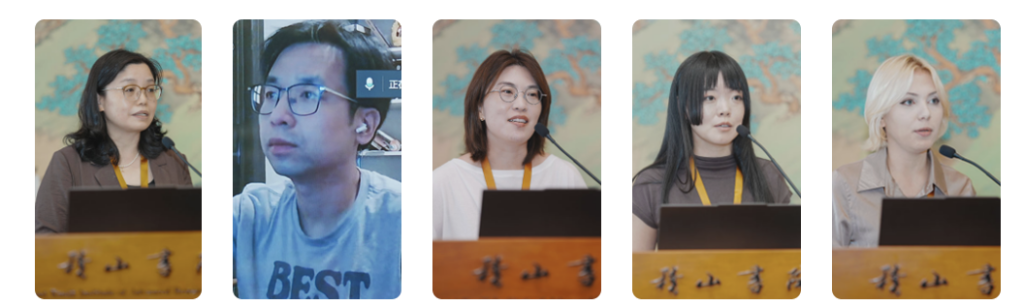
From left to right: He Rong, Ding Yi (Allan), Li Bohan, Hou Xiaoming, and Valeriia Solostova. Republished with permission.
Buddhist Texts, Manuscripts, and Digital Philology
Panel 2, “Buddhist Texts, Manuscripts, and Digital Philology,” brought together four presentations. Imre GALAMBOS of Zhejiang University delivered “The Sounds of Wisdom: Medieval Chinese Pronunciation of Bore.” Using manuscripts excavated along the Silk Road, he investigated how the Chinese transcription bore 般若, commonly used for prajñā (wisdom), was actually read during the Tang–Song period. By focusing on historical reading practice rather than the term’s presumed original pronunciation, the study connected phonological history, manuscript studies, and the history of Buddhist transmission.
CHEN Zhinan of Dunhuang Research Academy presented “The Continuation of the Indic ‘Mother of Stars’ Lore in the East: Chinese and Tibetan Manuscript Tradition of the Grahamātṛkādhāraṇī.” Although the Sūtra of the Zhuxingmu Dhāraṇī 諸星母陀羅尼經 (Skt. Grahamātṛkādhāraṇī), translated by Facheng in 842, does not appear in traditional catalogues or the Chinese Buddhist canon, more than seventy related manuscripts survive at Dunhuang. Through their codicological features, textual transmission, and local circulation, she identified the possibility of local, non-official translation mechanisms in the Hexi region under Tibetan rule, revealing the diversity of medieval Buddhist translation networks and frontier knowledge production.
LU Lu of Zhejiang University spoke on “In the Words of Lokakṣema: Function Words, Textual Attribution, and Stylistic Profiling with Language Models.” Combining language modeling with traditional philology, Lu compared T224 and T458 across conjunctions, prepositions, pronouns, adverbs, and passive constructions. She stressed that model results should not be treated as final verdicts on textual attribution. Instead, they should generate philological questions about how individual texts inherited, modified, or departed from the linguistic habits of the core Lokakṣema corpus, moving the discussion beyond a simple authentic–spurious binary. Nadine BREGLER of the University of Hamburg examined “Chinese Buddhist Texts in Joseon Korea: Manuscript Culture and Practices of Translation.” She proposed understanding translation as a continuum of textual practices through which Chinese Buddhist texts were repeatedly read, rewritten, and reinterpreted in religious, literati, and popular settings. Manuscript and print evidence thus shows textual transformation itself to have been a fundamental mechanism of translingual exchange and intellectual change in East Asia.
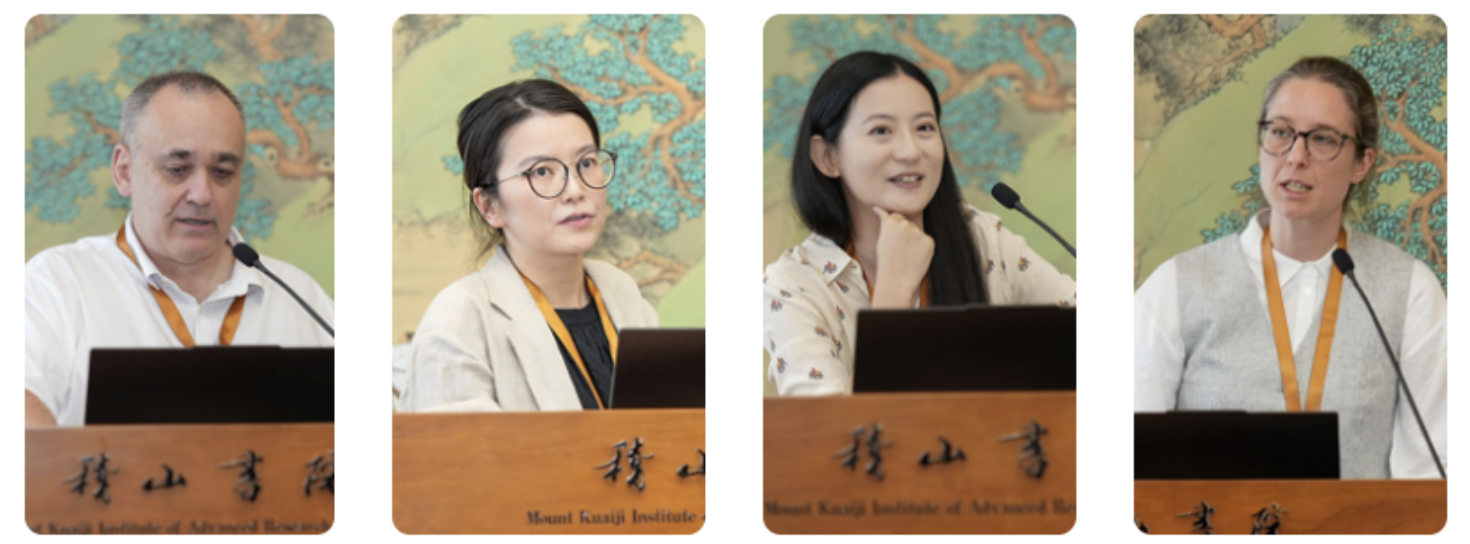
From left to right: Imre Galambos, Chen Zhinan, Lu Lu, and Nadine Bregler. Republished with permission.
Canon, Ritual, and Buddhist Practice
Panel 3, “Canon, Ritual, and Buddhist Practice,” included five presentations. FENG Guodong of Zhejiang University delivered “Catalogues, Rituals, and the Cult of Buddhist Scriptures: A Preliminary Study of Zhiguan’s Falun Baochan.” Focusing on the Fajie fansheng shuilu dazhai falun baochan 法界聖凡水陸大齋法輪寶懺, a ritual manual compiled by the Qing-dynasty monk Zhiguan 咫觀 for scripture reading during the Grand Water-and-Land Assembly, he examined Zhiguan’s life and writings and the text’s relationship with Ouyi Zhixu’s 蕅益智旭 Yuezang zhijin 閱藏知津. The study revealed close connections among Buddhist catalogues, scripture veneration, and repentance ritual.
YAMABE Nobuyoshi of Waseda University compared the descriptions of hell in “The Guanfo sanmei hai jing and the Datong fangguang jing on the Descriptions of the Hells: The Relationship between Two Apocryphal Sūtras.” Although the two scriptures are closely related, the generally later Datong fangguang jing 大通方廣經 appears to preserve an older and more coherent form of the narrative. This apparent reversal prompted a reconsideration of their compositional layers, textual sources, and mutual relationship.
Mónika KISS of Eötvös Loránd University, Budapest, presented “Textual and Ritual Evolution from China to Japan: The Case of the Yiqie rulai jingang shouming tuoluoni jing.” She traced the development and dissemination of related texts and rituals from China to Japan, asking whether one Chinese version should be understood as a translation or an adaptation of an existing text, and questioned whether the arrival of a new text in eleventh-century Japan encouraged monks to rediscover an earlier scripture and establish a new ritual tradition.
LUO Mujun and GE Peiyi of the School of Humanities, Zhejiang University of Technology presented “The Dissemination and Influence of Sinicised Buddhism: An Investigation Centred on the Apocryphal Scripture Gaowang Jing” and examined the formation, circulation, and cross-cultural influence of the Gaowang Guanshiyin Jing 高王觀世音經. The scripture gained authority by excerpting and reorganizing canonical Buddhist sources while adapting them to local religious needs. Its stable religious core—“reciting the scripture brings deliverance from death”—together with the continuing production and cross-media representation of miracle stories, sustained its remarkable vitality. Surviving Tangut and Korean translations further demonstrate its influence on Buddhist cultures beyond the Chinese heartland. JIN Mingjun of Sichuan University presented “From Translation to Meditation Practice: The Evolution and Comparative Study of the Fivefold Meditation System in the Dharmatrāta Dhyāna Sūtra and the Sūtra on the Samādhi of Seated Meditation.” He showed that the former structured cultivation through the path of expedient means, the superior path, and the stages of retrogression, abiding, advancement, and certainty, whereas the latter organized practice according to spiritual capacity and types of afflictions. The Five Gates of Meditation therefore did not exist from the outset as a fixed system; they gradually took shape through translation, compilation, interpretation, and local reception. Chinese meditation scriptures consequently did more than convey doctrine: they actively contributed to the formation of early Chinese Chan systems of meditative practice.
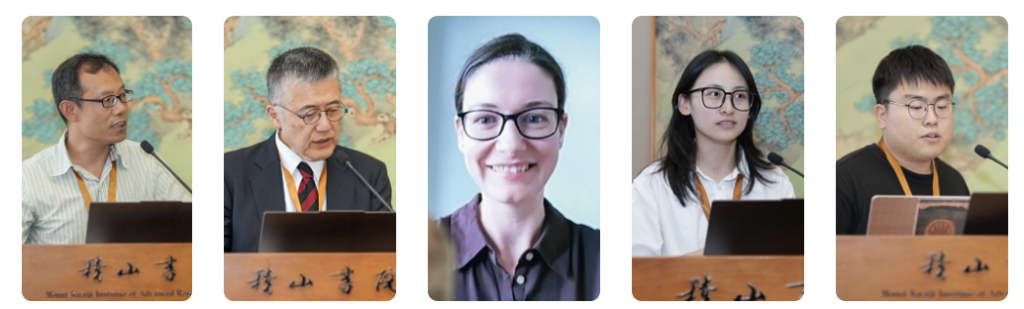
From left to right: Feng Guodong, Yamabe Nobuyoshi, Mónika Kiss, Ge Peiyi, and Mingjun Jin. Republished with permission.
East Asian Transmission and Cultural Transformation
Panel 4, “East Asian Transmission and Cultural Transformation,” comprised of five presentations. CHO Eunsu of Seoul National University delivered “The Goryeo Canon as Civilizational Currency: Philological Authority and Political Prestige in Medieval East Asia.” She proposed moving beyond a static interpretation of the canon through the lens of Buddhism for National Protection (Hoguk Bulgyo). Instead, the Goryeo Canon (Goryeo Daejanggyeong) should be understood as a dynamic transregional event involving scribes, carvers, diplomats, monks, and merchants. Its philological authority and editorial reliability enabled it to function as “Civilizational Currency,” mediating cultural legitimacy and political prestige across medieval East Asia.
KIM Jiyun of Dongguk University presented “From Reception to Transformation: The Transmission of the Xin Huayan jing lun in East Asia.” Comparing Li Tongxuan’s 李通玄 Xin Huayan jing lun 新華嚴經論 with related abridgements and commentaries, she traced how Huayan texts were selected, reorganized, and reinterpreted across China, Korea, and Japan. The wider regional comparison also established a stronger philological foundation for the future study of Li Tongxuan’s thought.
Sung-Eun Thomas KIM of Dongguk University examined “Korean Vernacular Translations of Sinitic Buddhist Texts: The Role of the Directorate of Sūtra Publication.” The presentation placed the Directorate’s translation and publication of Buddhist works within the historical context of the Joseon court, where support for Buddhism remained bounded by state-defined Confucian norms. The published texts accordingly reveal the complex relationship among governance, religious policy, and Buddhism’s social position.
Dipen BARUA of The University of Hong Kong delivered “Reviving Buddhist Heritage: Bengali Translations of Pāli Literature and Buddhist Studies in Bengal from the 1850s to the Present.” He surveyed the revival of Theravada Buddhism, the translation and publication of the complete Pāli Canon, and the emergence of Pāli studies as an independent academic field in Bengal. He also highlighted how transmitted teachings and texts from Burma and Sri Lanka shaped Bengali Theravada Buddhism and stressed the continuing importance of preserving Buddhist heritage in a changing socio-cultural landscape.
ZHANG Rui of Université Lumière Lyon 2 / Institut d’Asie orientale presented “From Hanshan to Montfroid: Translation, Reception, and the Modern Making of a Poetic-Spiritual Figure.” The French reception of Hanshan 寒山 showed how works carrying Buddhist resonances may be reinterpreted as they circulate globally. Translation, she argued, not only transmits ideas but also shapes frameworks of reading and reconfigures the relationship among literature, religion, and philosophy, thereby participating directly in cross-cultural transformations of meaning.
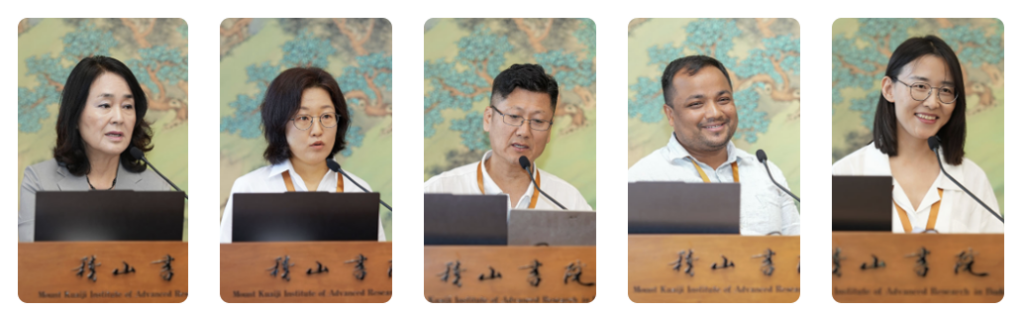
From left to right: Cho Eunsu, Kim Jiyun, Sung-Eun Thomas Kim, Dipen Barua,and Zhang Rui. Republished with permission.
Translation, Translation Teams, and Buddhist Knowledge Networks
Panel 5, “Translation, Translation Teams, and Buddhist Knowledge Networks,” featured five speakers. John JORGENSEN, an independent scholar, presented “Early Buddhist Translations and the Role of Confucian Philology with a Focus on An Shigao and His Circle.” Taking the unusual rendering of skandha (aggregates) as yin 陰 (hidden, shaded) as a central example, he suggested that certain early Buddhist translation choices were shaped by derived meanings already assigned to Chinese characters in Confucian philology.
LI Xuetao of Beijing Foreign Studies University spoke on “Translation across Languages: Kumārajīva and the Making of a Multilingual Buddhist Knowledge Network.” He argued that Buddhist translation should be understood not merely as transfer between two languages, but as a mechanism of knowledge production involving translators, monastic communities, texts, and political-cultural environments. Early Chinese Buddhism was continuously formed within precisely such transcultural and multilingual networks.
Tom NEWHALL of the University of Tokyo presented “From Translation to Interpretation to Application: The Translation of the Vinaya and the Development of Monasticism and the Vinaya School in China.” He outlined translation, interpretation, and application as three central dimensions in the development of the Vinaya tradition, while emphasizing that they did not always occur in a fixed order or in isolation. Nor did everything written in the Vinaya pass directly into monastic institutions. The writings of Daoxuan offer a particularly important perspective on the interaction between translated disciplinary texts and East Asian monastic practice.
LI Wei of Henan University delivered “Metaphor as Translation Strategy: Literati Scribes and the ‘Wen-Zhi’ Tension in Early Medieval Chinese Buddhist Translations.” He argued that the literary and analogical beauty of Chinese Buddhist translations resulted from the sustained refinement of literati scribes amid debates over style (wen 文) or substance (zhi 質). This process constituted both a textual dimension of the Sinicization of Buddhism and an important mechanism in the transcultural aesthetic formation of early medieval China. CHEN Jinhua of the University of British Columbia presented “Tracing Divākara’s Activities in Luoyang and Chang’an.” By integrating hagiographies, bibliographical catalogues, prefaces, inscriptions, and political history within a unified analytical framework, he reconstructed Divākara’s 地婆訶羅 activities and established a firmer chronological basis for understanding his translation enterprise. The study demonstrated the broader methodological value of reading diverse documentary genres together when reconstructing Tang translation bureaus, Buddhist knowledge networks, and the history of Sino-Indian Buddhist exchange.
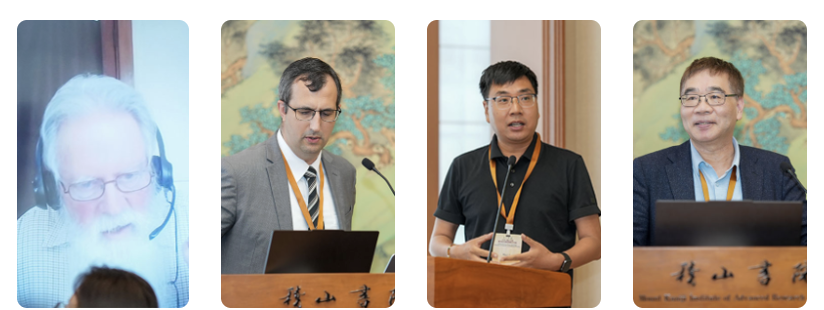
From left to right: John Jorgensen, Tom Newhall, Li Wei, and Jinhua Chen. Republished with permission.
Buddhist Thought and Conceptual Transformation
Panel 6, “Buddhist Thought and Conceptual Transformation,” included four presentations. YAN Yaozhong of Shanghai Normal University delivered “The Influence of the Concept of ‘Identity’ in Buddhist Texts in China.” He showed how Chinese Buddhist translations, as indispensable vehicles for the transmission of Buddhism, also introduced new meanings into existing Chinese vocabulary. The development of “identity” into a concept with wide social and intellectual significance exemplifies the profound influence of translation on language and cultural understanding.
SUN Yinggang of Zhejiang University presented “A Study of Mount Dandaka: The Sacred Site of Prince Sudāna’s Jātaka in Textual and Visual Traditions.” Drawing on textual and visual materials, he traced how Mount Dandaka, originally the place of Prince Sudāna’s exile, became an important Buddhist sacred site and acquired different interpretations in the pilgrimage records of Chinese monks, Tibetan Buddhist historical narratives, and Chan texts. Its changing significance demonstrates the continual reconstruction of Buddhist sacred geography through transregional transmission.
PARK Chongdok C.H. of Dongguk University delivered “Glorifying the Order and Creating Great Monks: A Critical Survey of Oral History in Modern Korean Buddhist Studies.” While affirming the value of oral testimony in reconstructing Korea’s modern Buddhist past, he critically examined methodological limitations and institutional biases in existing scholarship. He called for greater methodological rigor, broader source bases, and the inclusion of more diverse narrative subjects in future research.
WANG Yue of Kyoto University presented “Two Divergent Lives of Smṛti: Conceptual Reconfiguration as Niàn (念) and Mindfulness.” Drawing on Yogācāra and Abhidharma sources, she distinguished niàn (念)—a mental factor that retains a familiar object and prevents distraction—from ordinary memory. She contrasted it with mindfulness, reformulated in modern English as non-judgmental awareness of present experience and widely adapted to psychology, medicine, and education.
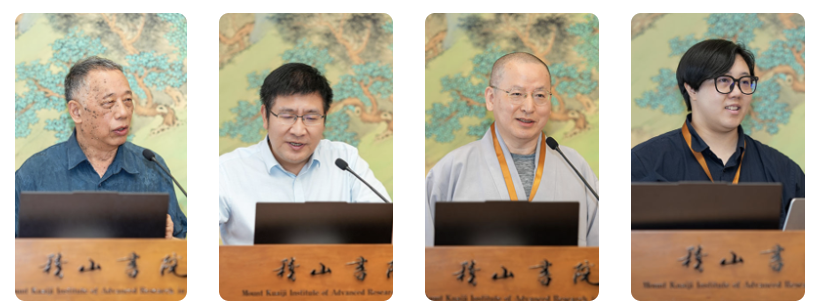
From left to right: Yan Yaozhong, Sun Yinggang, PARK Chongdok C.H., and Wang Yue. Republished with permission.
Source: Original Post


