
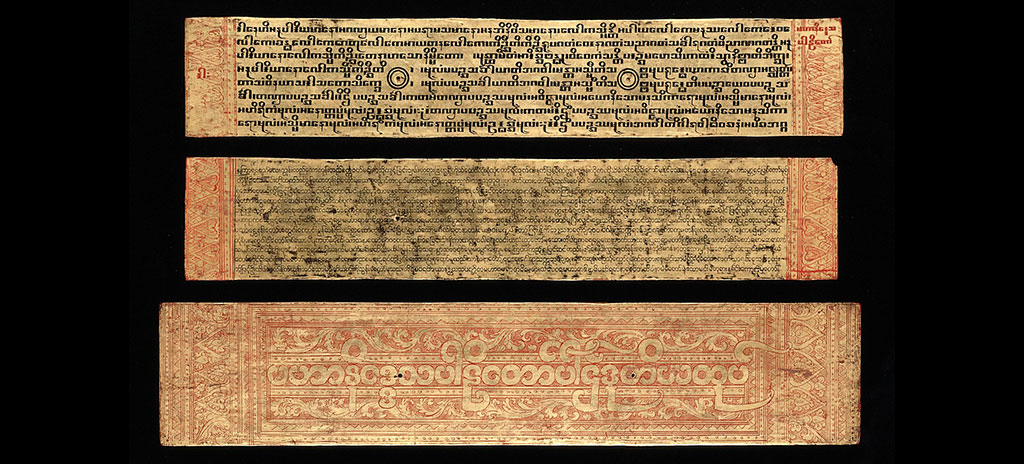
Burmese-Pali Manuscript. Wellcome Collection. Source: Wellcome Collection.
Speaker: Eviatar Shulman, Professor, The Hebrew University of Jerusalem
Date & Time: Thursday, April 29, 2026, 5 p.m. Pacific
Venue: 370 Dwinelle Hall, UC Berkeley
Sponsor: Numata Center for Buddhist Studies, Glorisun Global Buddhist Network
Contact Info: Sanjyot Mehendale, (510) 643-5104, buddhiststudies@berkeley.edu
Access Coordinator: Sanjyot Mehendale, buddhiststudies@berkeley.edu, (510) 643-5104
Abstract: Abhidharma is commonly presented as a later layer of Buddhist doctrinal development, which made an effort to systematize the early Buddhist teachings, especially as these were preserved in the early Discourses (sūtra, sutta). However, we know that the latter probably took shape over a large span of time, while scholars have also pointed out that parts of Abhidharma return to earlier periods. Focusing on the oral nature of the Pāli Abhidhamma collections allows us problematize this issue further. If an oral text is defined in this context by its formulaic nature and the amount of repetition it is based on, then what do we learn when we discover that the repetition in Abhidhamma far exceeds that of Sutta? This could suggest that the materials that grew to become the texts we read today, but which were first probably phenomenological exercises (spanning both observation and theory), can be seen as a particular approach to Buddha-dharma, rather than as a later elaboration. The atomic conception of this tradition as if it defines dhammas as ultimate particulars, which may be true of the northern tradition, does not apply here either. These ideas will be addressed through an analysis of some of the oral patterns in central Abhidhamma texts like the Dhammasaṅgaṇī, Vibhaṅga and Paṭṭhāna.
Speaker: Eviatar Shulman teaches Buddhist philosophy and religion at the Hebrew University of Jerusalem in the Departments of Comparative Religion and Asian Studies. He is head of the of the Institute for the Study of History, Religion and Culture. He has authored Rethinking the Buddha: Early Buddhist Philosophy as Meditative Perception (Cambridge University Press, 2014) and Visions of the Buddha: Creative Dimensions of Early Buddhist Scripture (OUP, 2021), as well as many articles in leading journals.
See the original event posting here.


