
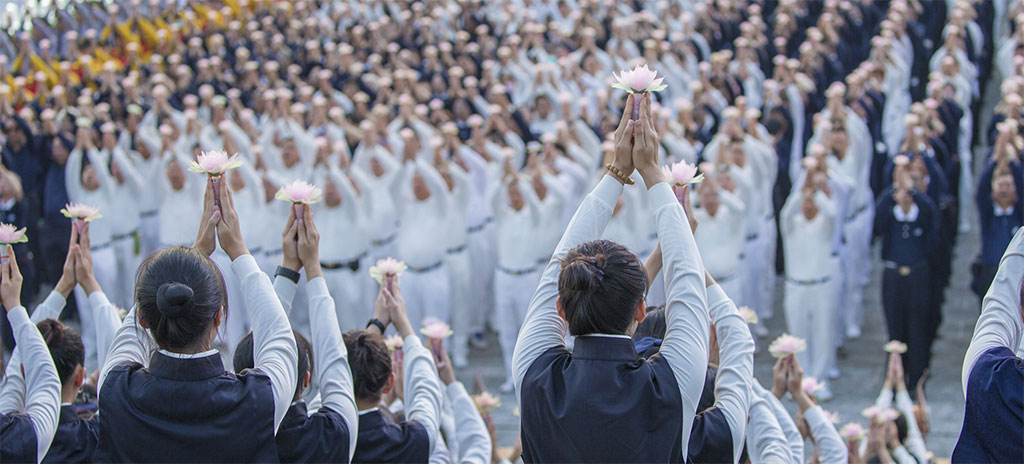
Tzu Chi Day, May 13, 2018. Taiwan Presidential Office, via Wikimedia Commons.
Speaker: Rey Sheng Her (Tzu Chi Foundation)
Date: Monday 12 October 2026
Basement Teaching Room 1 at 5:00pm
Faculty of Asian and Middle Eastern Studies
Pusey Lane, Oxford, OX1 2LE
All Welcome
Tea and snacks at 4:30–4:50pm (Common Room in the basement)
All enquiries: yuling.wu@balliol.ox.ac.uk
Glorisun Lecture Series in Buddhist Studies, Michaelmas Term 2026
Kindly supported by Glorisun Global Network for Buddhist Studies
Abstract:
To maintain institutional endurance, religious traditions must adapt to contemporary societal needs. Drawing on analyses by Max Weber and Venerable Yinshun alongside historical developments in India, Sri Lanka, Joseon Korea, and post-Tang China, this paper argues that the long-term vitality of Buddhism depends on “applied Buddhism”—the systematic integration of Buddhist wisdom across all worldly domains. This paper presupposes that, historically, Buddhism declined whenever restricted to monastic enclaves, relinquishing governance, epistemology, and daily ethics to Brahmanism or Confucianism; conversely, Abrahamic traditions sustained social prominence by forging comprehensive normative frameworks for civic life.
The paper traces modern Chinese Buddhism’s trajectory to correct this imbalance, following Master Taixu’s “Buddhism for Human Life,” Venerable Yinshun’s “Humanistic Buddhism,” and Dharma Master Cheng Yen’s Tzu Chi movement. It locates the term “applied Buddhism” at the turn of the twentieth century in Liang Qichao’s commentary on Tan Sitong’s Renxue (仁學). Tan synthesized Yogācāra, Huayan, and Prajñā thought to dismantle hierarchical dualities and promote egalitarian reform, culminating in his 1898 martyrdom.
Positioning Tzu Chi as a paradigm of applied Buddhism rooted in the Sūtra of Infinite Meanings, the paper examines how its core principles—”emptiness and quiescence of nature and form” and “liberating sentient beings”—inform its missions in charity, medicine, education, and humanistic culture. Tzu Chi operationalizes practice through three tenets: engaging in worldly labour with a mind of renunciation, giving unconditionally, and entering nirvana without severing afflictions, thereby framing altruism as the path to enlightenment.
Speaker:
Dr. Rey-Sheng Her is Deputy CEO at the Tzu Chi Foundation, Senior Fellow at Harvard University, and former visiting scholar at Oxford University. He holds a Ph.D. in Philosophy from Peking University. A leading authority on contemporary humanistic Buddhism and altruistic governance, Dr. Her bridges theoretical Buddhist philosophy with decades of real-world practice. He has spearheaded major international disaster relief operations and faith-based NGO initiatives across the globe. Dr. Her is also the initiator of the Yin-Cheng Network for Buddhist Studies and an advocate for the Economy of Goodness. His publications include The Economy of Goodness and The Essential Studies of Tzu Chi Buddhism. Combining academic rigour with practical humanitarian experience, Dr. Her’s work offers profound insights into applying Buddhist principles to modern societal and economic challenges.


